Dijon & Beaune’s Truffle Escapade
Travel to the heart of the legendary Burgundy region, and discover gothic palaces, curious old hospitals, world-class truffles, and Dijon mustard.
Highlights
- -Dijon architecture and Tour Philippe le Bon views.
- -Fallot Mill traditional mustard crafting.
- -Hôtel-Dieu's Renaissance facade and tiled roof.
- -Burgundy truffle hunting and Champitruffes tastings.
Gallery
About this experience
Guide and Driver will pick up clients from their hotel or residence. On the way to the discovery the guide will illustrate on the specialities of the region of Burgundy.
The guide will escort the clients throw the small city of Dijon discovering all its heritage, history and delightful cuisine. They’ll be guided past the famous Palace of the Dukes and Burgundy States, Cathedrale Saint-Bénigne de Dijon, La Place de la Libération and much more. Then they will finish at the top of Tour Philippe le Bon and view the whole of Dijon.
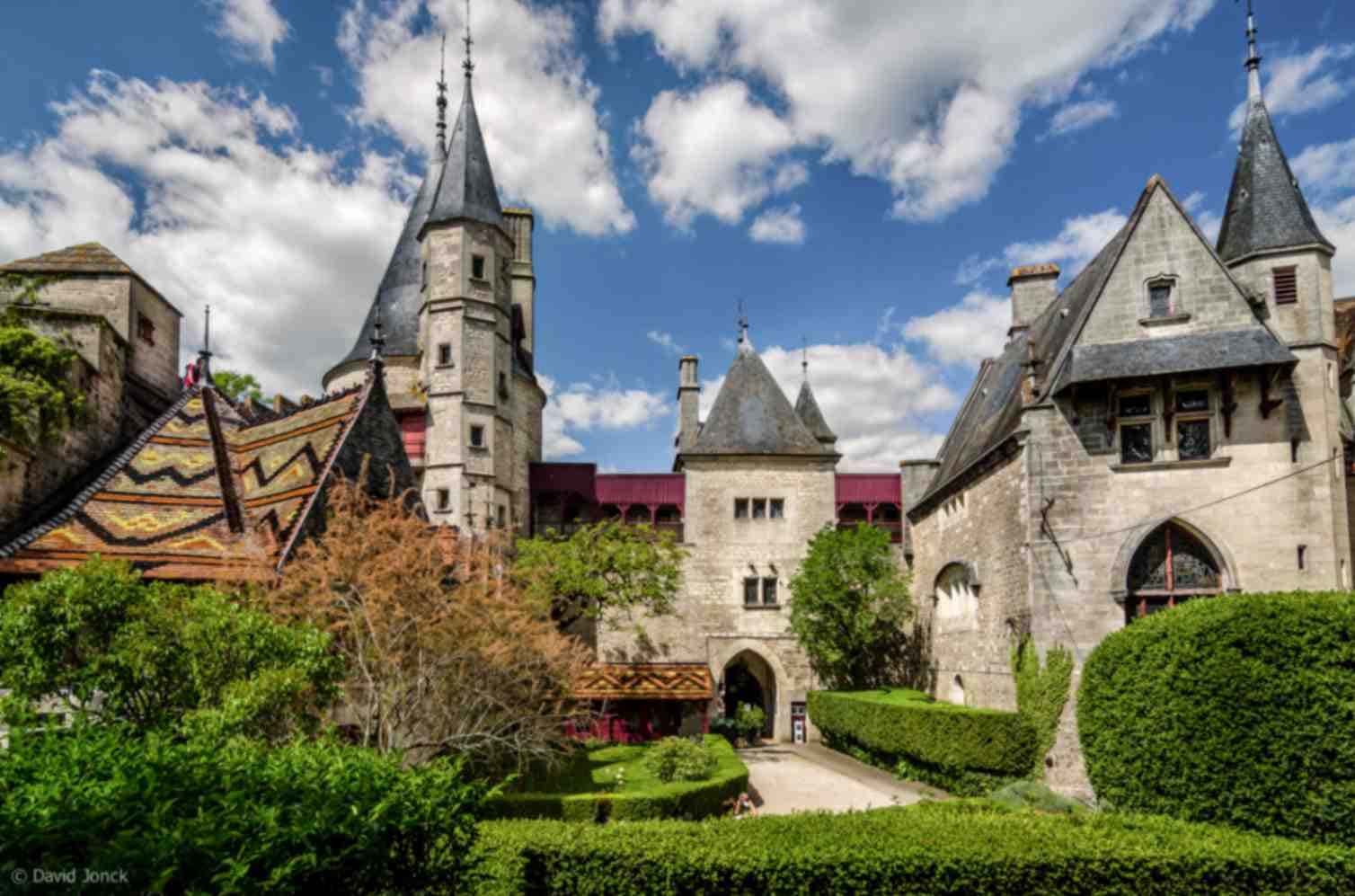
Dijon - The earliest archaeological finds within the city limits of Dijon date to the Neolithic period. Dijon later became a Roman settlement named Divio, located on the road from Lyon to Paris. The province was home to the Dukes of Burgundy from the early 11th until the late 15th centuries, and Dijon was a place of tremendous wealth and power, one of the great European centres of art, learning, and science. In 2017, the commune had a population of 156,920; the Greater Dijon area had 250,516 inhabitants in 2007. The city has retained varied architectural styles from many of the main periods of the past millennium, including Capetian, Gothic, and Renaissance. Many still-inhabited town houses in the city's central district date from the 18th century and earlier. Dijon architecture is distinguished by, among other things, toits bourguignons (Burgundian polychrome roofs) made of tiles glazed in terracotta, green, yellow, and black and arranged in geometric patterns.
Palace of the Dukes and Burgundy States - The Duchy of Burgundy was founded in the 9th century, around the year 880, from the Kingdom of Burgundy by the Carolingian kings of France, Louis III and Carloman II, and the Princes who shared the Carolingian Empire, after reorganizing the entire kingdom into duchies and counties. Richard, Count of Autun, known as ""Richard the Justiciar"", was named the first Margrave and Duke of Burgundy. He was one of the six in the French Peerage installed under his suzerain, King Louis III of France. Cathedrale Saint-Bénigne de Dijon - Originating as the church of the Abbey of St. Benignus, it became the seat of the Diocese of Dijon during the French Revolution, replacing the previous cathedral when it was secularised, and has been the seat of the succeeding Archbishopric of Dijon since the elevation of the diocese in 2002. The first church here was a basilica built over the falsely reported sarcophagus of Saint Benignus, which was placed in a crypt constructed for it by Saint Gregory of Langres in 511; the basilica over the crypt was completed in 535. This building became the centre of a monastic community. In 871 Isaac, Bishop of Langres, re-founded it as a Benedictine abbey, and restored the basilica at the same time.
In 989 Bruno, Bishop of Langres, requested Mayeul, Abbot of Cluny, to send monks to re-settle the abbey, grown decadent, as a Cluniac house. In 990 William of Volpiano was appointed the new abbot. By 1002, the ruin of the previous building had been razed and construction began on a new Romanesque structure designed by William, consisting of a subterranean church round the sarcophagus of Benignus, a ground floor church for worship, and a rotunda, 17 metres in diameter, on three levels in the place of the apse, linking the two. Dedicated in 1016 by Lambert I, this suite of buildings was decorated in the ornate Cluniac style, of which only a few traces survive. In 1137 a fire destroyed most of the town of Dijon and damaged the monastery and its church. The repaired building was consecrated by Pope Eugene III in 1147.
In 1272 the crossing tower collapsed, destroying the whole of the upper church and severely damaging the subterranean one, and smashing some of the supporting columns of the rotunda. Then the abbot, Hugh of Arc, of a powerful Burgundian family, was able thanks to his contacts to mobilise enough support to begin the construction of a new Gothic abbey church in 1281. Progress was at first rapid, and at Hugh's death in 1300 the building was close to completion. Progress slowed, however, and the work was not finished until 1325. The new church, unlike its Cluniac predecessor, is noted for its plainness and severity. The abbey was secularised during the French Revolution, but the church was made, firstly, a parish church, and then in 1792 the cathedral of the Diocese of Dijon. The rotunda was however destroyed at that time; all that remains is the lowest storey, which was excavated in the 19th century and has since been reworked as a crypt.
Tour Philippe le Bon - From its 46 m height, the Philippe le Bon tower offers an exceptional panorama over the city of Dijon and its surroundings. The Philippe le Bon Tower, originally called the terrace tower, overlooks the entire Palace of the Dukes and the States of Burgundy. Built between 1450 and 1460 for Philippe le Bon at the same time as the ducal home, it recalls the prestigious medieval past of Dijon under the reign of the Grand Dukes of Valois. The plans for the palace are due to a Lyon architect named Jean Poncelet."
The clients will head to a local Mustard workshop where they will embark into the discovery of french mustard, greeted by a representative they will participate in the making of mustard exploring how it is crafted, discover the heritage of Mustard in Dijon and in french cuisine and finish with tasting their own creations and a variety of other mustards. Fallot Mustard Mill - Endowed with a successful facilities, it knew how to protect the know-how of the craftsman mustardmaker ; the grinding of seeds in the stony grindstone which protects all the gustative qualities of the dough. A quite particular attention is brought to the conservation and to the environmental protection : sorting and valuation of our waste, treatments of our effluents. Marc Désarménien, the grandson of Edmond Fallot, is at present in charge of the company.
About twenty employees contribute to the quality of the production. The company enriched its range of products over the years with aromatics mustards, vinegars, and others condiments like pickles; with a manufacturing process answering a quality approach in which La Moutarderie Fallot made a commitment. In 1840, Léon BOULEY founded a mustard mill and oil producers way back in 1840. It was not long before the quality of his products was noticed and recognised by his peers, resulting in the award of a diploma from the City of Paris, in 1903 during the Great International Exhibition. His inheritors, anxious to preserve this renown, were to continue in his footsteps, paying the utmost attention to the quality of their products and marrying tradition with innovation.
The guide will lead the clients inside the famous Hospice de Beaune where the guide will unravel the history and unique architecture of the Hospice which became a trend within the burgundy region. Beaune - Beaune is one of the key wine centers in France, and the center of Burgundy wine production and business. The annual wine auction of the Hospices de Beaune is the primary wine auction in France. (The hospice structure, in the town center, being one of the best preserved renaissance buildings in Europe.). The town is surrounded by some of the world's most famous wine villages, while the facilities and cellars of many producers, large and small, are situated in the historic center of Beaune itself, as they have been since Roman times.
With a rich historical and architectural heritage, Beaune is considered the ""Capital of Burgundy wines”. It is an ancient and historic town on a plain by the hills of the Côte d'Or, with features remaining from the pre-Roman and Roman eras, through the medieval and renaissance periods. Beaune is a walled city, with about half of the battlements, ramparts, and the moat, having survived in good condition. The central ""old town"" or ""vieille ville"" is extensive. Historically Beaune is intimately connected with the Dukes of Burgundy.,Landmarks in Beaune include the old market (les Halles), the 15th-century Hospices, the Beffroi (clock tower), and the collegiate church of Notre Dame. Beaune is the main center for the ""Burgundian tile"" polychrome renaissance roofing style of the region.
Hospice de Beaune - The Hôtel-Dieu was founded on 4 August 1443, when Burgundy was ruled by Duke Philip the Good. The Hundred Years' War had recently been brought to a close by the signing of the Treaty of Arras in 1435. Massacres, however, continued with marauding bands (écorcheurs) still roaming the countryside, pillaging and destroying, provoking misery and famine. The majority of the people of Beaune were declared destitute. Nicolas Rolin, the Duke's Chancellor, and his wife Guigone de Salins, responded by building a hospital and refuge for the poor. The majority of the population of Beaune were destitute, and the area had recently suffered an outbreak of plague. Having gained permission from Pope Eugene IV in 1441, the hospice was built and consecrated on 31 December 1452.
In conjunction, Rolin established the ""Les sœurs hospitalières de Beaune"" religious order. The building's design was probably overseen by the Flemish architect Jacques Wiscrère and remained as a hospital until the late 1970s. There is a documentary record of a large range of Flemish and French masons, painters and glass cutters employed for its construction. The facade is today regarded as a superior example of Northern Renaissance civic architecture and a treasure trove of panel painting, given its numerous portraits of Rolin, his wife and members of his extended family. The Hospices de Beaune consists of a pair of two-storied buildings arranged around a stone courtyard. The building wings are well-preserved today; they contain half-timber galleries and ornate rooftops with dormer windows. The hospital is arranged so that the wings served the office, kitchen and apothecary functions. The nuns and patients were housed nearer the chapel, towards the center of the complex.
The Hospices de Beaune received the first patient on 1 January 1452. Elderly, disabled and sick people, with orphans, women about to give birth and the destitute have all been uninterruptedly welcomed for treatment and refuge from the Middle Ages until today. This Catholic institution focused on healing both the body and spirit of its patients. Over the centuries, the hospital radiated outwards, grouping with similar establishments in the surrounding villages of Pommard, Nolay, Meursault. Many donations - farms, property, woods, works of art and of course vineyards - were made to it, by grateful families and generous benefactors. The institution is one of the best and oldest examples of historical, philanthropic, and wine-producing heritage, and has become linked with the economic and cultural life of Burgundy. Greeted by the representative the clients will be guided into the wonderful life of truffle hunting and explore the different techniques used to hunt truffle with hunting dogs. Then after, they will enjoy a delightful truffle tasting.
Champitruffes - The truffles of burgundy are perhaps less known than their cousins, the black truffles of Perigord or the white truffle of Italy. However, they are now met more enthusiastically by the mushroom connoisseur and are consequently acquiring reputation on pas with the mushrooms of highest quality. The breakout of truffles and their natural relationship with the earth, give us the gift of pleasure and sense of thrill rather than a sense of work.
The guide will bring the clients back to the hotel or residence.