Brittany and Mont-Saint-Michel’s Heritage
Lose yourself in the fairytale world of Mont-Saint-Michel and Brittany, as you explore its magical seaside surroundings.
Highlights
- -Explore Mont-Saint-Michel's streets and fortifications.
- -Explore the sacred abbey and its medieval legends.
- -Discover Normandy and Brittany's rich history.
- -Taste authentic Calvados with scenic sea views.
Gallery
About this experience
The driver and guide will pick up clients from their hotel or residence. On the way, the guide will explain the regional heritage of Normandy, cuisine and traditions.
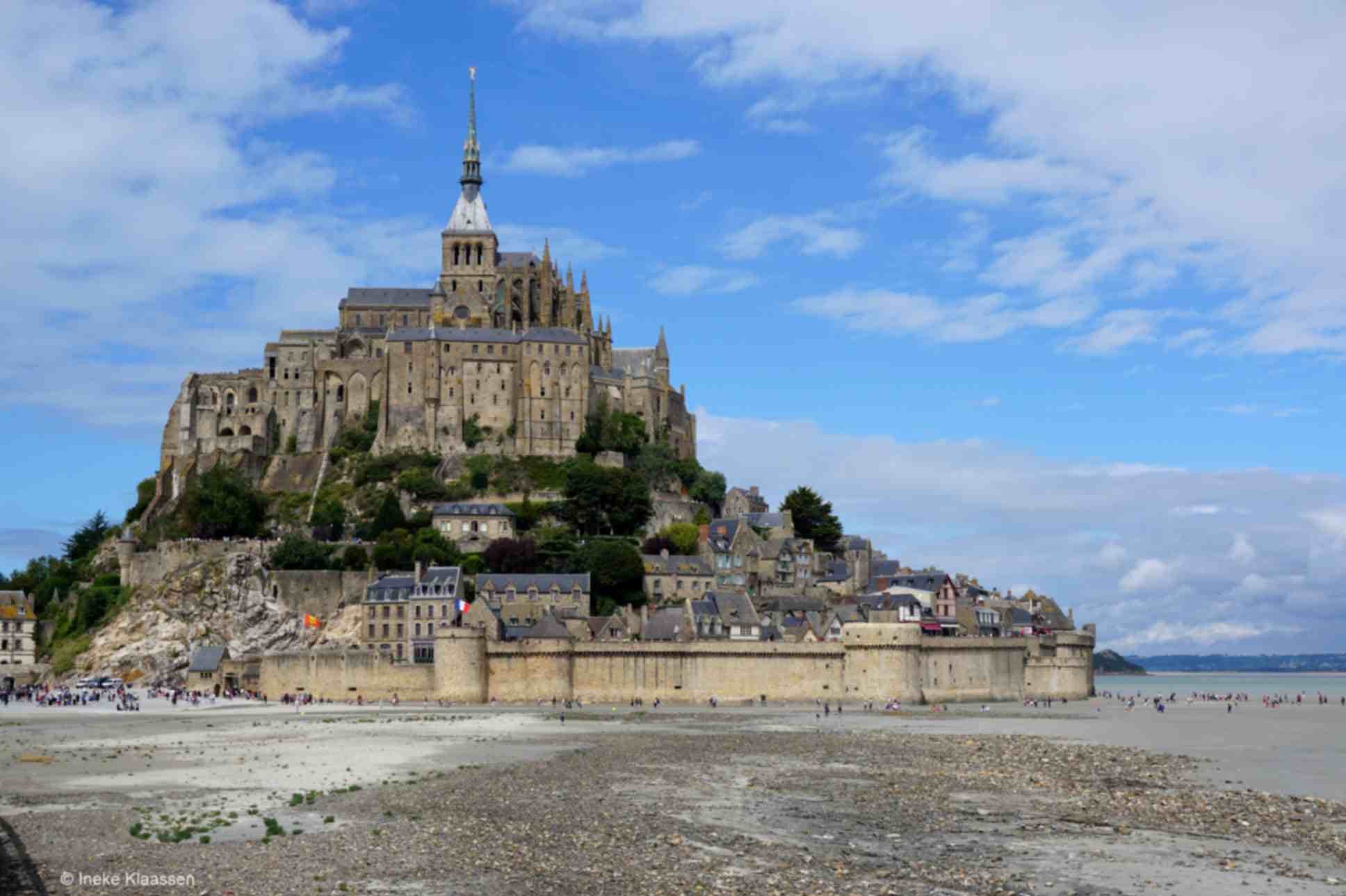
The guide will stroll through the old town of Mont-Saint-Michel, explaining the client the heritage of this UNESCO World Heritage site and how it prevailed in becoming very unique. Then on, the clients will explore the deepest secrets which one of the most visited spots in France. Mont-Saint-Michel - The original site was founded by an Irish hermit, who gathered a following from the local community. Mont-Saint-Michel was used in the sixth and seventh centuries as an Armorican stronghold of Gallo-Roman culture and power until it was ransacked by the Franks, thus ending the trans-channel culture that had stood since the departure of the Romans in 460. From roughly the fifth to the eighth century, Mont Saint-Michel belonged to the territory of Neustria and, in the early ninth century, was an important place in the marches of Neustria. Before the construction of the first monastic establishment in the 8th century, the island was called Mont Tombe (Latin: tumba).
According to a legend, the archangel Michael appeared in 708 to Aubert of Avranches, the bishop of Avranches, and instructed him to build a church on the rocky islet. Unable to defend his kingdom against the assaults of the Vikings, the king of the Franks agreed to grant the Cotentin peninsula and the Avranchin, including Mont Saint-Michel traditionally linked to the city of Avranches, to the Bretons in the Treaty of Compiègne (867). This marked the beginning of a brief period of Breton possession of the Mont. In fact, these lands and Mont Saint-Michel were never really included in the duchy of Brittany and remained independent bishoprics from the newly created Breton archbishopric of Dol. When Rollo confirmed Franco as archbishop of Rouen, these traditional dependences of the Rouen archbishopric were retained in it. The mount gained strategic significance again in 933 when William I Longsword annexed the Cotentin Peninsula from the weakened Duchy of Brittany. This made the mount definitively part of Normandy, and is depicted in the Bayeux Tapestry, which commemorates the 1066 Norman conquest of England.
Harold Godwinson is pictured on the tapestry rescuing two Norman knights from the quicksand in the tidal flats during a battle with Conan II, Duke of Brittany. Norman ducal patronage financed the spectacular Norman architecture of the abbey in subsequent centuries. In 1067 the monastery of Mont Saint-Michel gave its support to William the Conqueror in his claim to the throne of England. This he rewarded with properties and grounds on the English side of the Channel, including a small island off the southwestern coast of Cornwall which was modelled after the Mount and became a Norman priory named St Michael's Mount of Penzance. During the Hundred Years' War, the Kingdom of England made repeated assaults on the island but was unable to seize it due to the abbey's improved fortifications. The English initially besieged the Mont in 1423–24, and then again in 1433–34 with English forces under the command of Thomas de Scales, 7th Baron Scales. Two wrought-iron bombards that Scales abandoned when he gave up his siege are still on site. They are known as les Michelettes. Mont Saint-Michel's resolute resistance inspired the French, especially Joan of Arc.
When Louis XI of France founded the Order of Saint Michael in 1469, he intended that the abbey church of Mont Saint-Michel become the chapel for the Order, but because of its great distance from Paris, his intention could never be realized. The wealth and influence of the abbey extended to many daughter foundations, including St. Michael's Mount in Cornwall. However, its popularity and prestige as a centre of pilgrimage waned with the Reformation, and by the time of the French Revolution there were scarcely any monks in residence. The abbey was closed and converted into a prison, initially to hold clerical opponents of the republican regime. High-profile political prisoners followed, but by 1836, influential figures—including Victor Hugo—had launched a campaign to restore what was seen as a national architectural treasure. The prison was finally closed in 1863.
In 1872, the highly decorated French architect of historic monuments, Edouard Corroyer, was responsible for assessing the condition of the Mont. It took him about two years to convince his minister to classify Mont Saint-Michel a historic monument, and it was officially declared as such in 1874. From then on, this highly qualified and educated architect, member of the Academy of Fine Arts, devoted himself entirely to the restoration of "la Merveille". Under his direction, gigantic works were undertaken, starting with the most urgent. Édouard Corroyer devoted fifteen years of his life to this work and wrote four works on the building. The name of Edward Corroyer remains forever attached to the "resurrection" of Mont Saint-Michel. Mont Saint-Michel and its bay were added to the UNESCO list of World Heritage Sites in 1979, and it was listed with criteria such as cultural, historical, and architectural significance, as well as human-created and natural beauty.
After their lunch, the guide will escort the client up steep stairs and reach the Mont-Saint-Michel Abbey explaining the it’s history and how essential it is to Mont-Saint-Michel to this day. Mont-Saint-Michel-Abbey - The first text about an abbey is the 9th-century Latin text Revelatio ecclesiae sancti Michaelis in monte Tumba written by a chanoine living at Mont Saint Michel or at the Cathédrale Saint-André d'Avranches. This text was written at a time of power struggle between Brittany and the County of Normandy against Francia as well as during canon law reforms by Roman emperors. When Christianity expanded to the area, around the 4th century, Mont Tombe – the original name of Mont Saint Michel – was part of the Diocese of Avranches.
By the middle of the 6th century, Christianity had a stronger presence in the bay. By this time, Mont Tombe was populated by religious devotees – hermits (probably some Celtic monks) supplied by the curé of Astériac, who took care of the site and led a contemplative life around some oratories. The hermits Saint Pair and Saint Seubilion dedicated one of the oratories to Saint Étienne, midway through the mont, and one to Saint Symphorien, at the foot of the rock.
In 710, Mont Tombe was renamed Mont Saint Michel au péril de la Mer ("Mount Saint Michael at the peril of the sea") after an oratory was erected to Saint Michael by bishop Saint Aubert of Avranches in 708. According to the legend, Aubert received, during his sleep, three times the order from Saint Michael to erect an oratory on the Mont Tombe. The archangel was reputed to have left his finger mark on Aubert's skull. This skull is displayed at the Saint-Gervais d'Avranches basilica with such a scar on it. This sanctuary should be, according to the archangel, a replica of the Gargano in Italy (from the 5th century). Aubert had a local religious artifact removed and instead a circular sanctuary built, made of dry stones.
Around 708, Aubert sent two monks to get some artifacts from the Italian sanctuary Gargano (a rock with his foot print and a piece of tissue from the altar). During this mission, the March 709 tsunami is supposed to have destroyed the Scissy forest and turned the Mont into an island. On October 16, 709, the bishop dedicated the church and put twelve chanoine there. The Mont-Saint-Michel was born. The remains of the oratory were found in the chapel Notre-Dame-Sous-Terre. This sanctuary contained the tomb of Aubert and most likely the artifacts brought from Gargano. The chapel Notre-Dame-Sous-Terre is today under the nave of the abbey-church.The first buildings became t oo small and under the Western Roman Empire multiple buildings were added. Charlemagne chose Saint Michel as a protector of his empire during the 9th century and tried to have the place renamed Mont-Saint-Michel, but during the Middle Ages it was usually called Saint-Michel-aux-Deux-Tombes (Saint Michel with two tombs) (Mons Sancti Michaelis in periculo maris, in reference to Tombelaine). Before the second discovery the guide will give the clients 30m free time for lunch
Then on, the clients will enjoy a calvados tasting in front of the Mont-Saint-Michel island for a magnificent view. Normandy Calvados - Apple orchards and brewers are mentioned as far back as the 8th century by Charlemagne. The first known record of Norman distillation was made by squire Gilles de Gouberville in 1553, and the guild for cider distillation was created about 50 years later in 1606. In the 17th century, the traditional cider farms expanded, but taxation and prohibition of cider brandies were enforced elsewhere than Brittany, Maine, and Normandy. The area called "Calvados" was created after the French Revolution, but eau de vie de cidre was already called calvados in common usage.
In the 19th century, output increased with industrial distillation and the working class fashion for café-calva. When a phylloxera outbreak in the last quarter of the 19th century devastated the vineyards of France and Europe, calvados experienced a "golden age". During World War I, cider brandy was requisitioned for use in armaments due to its alcohol content. The appellation contrôlée regulations officially gave calvados a protected name in 1942. After the war, many cider houses and distilleries were reconstructed, mainly in the Pays d'Auge. Many of the traditional farmhouse structures were replaced by modern agriculture with high output. The calvados appellation system was revised in 1984 and 1996. Pommeau got its recognition in 1991; in 1997, an appellation for Domfront with 30% pears was created.
The driver and guide will bring the clients back to the hotel or residence.